
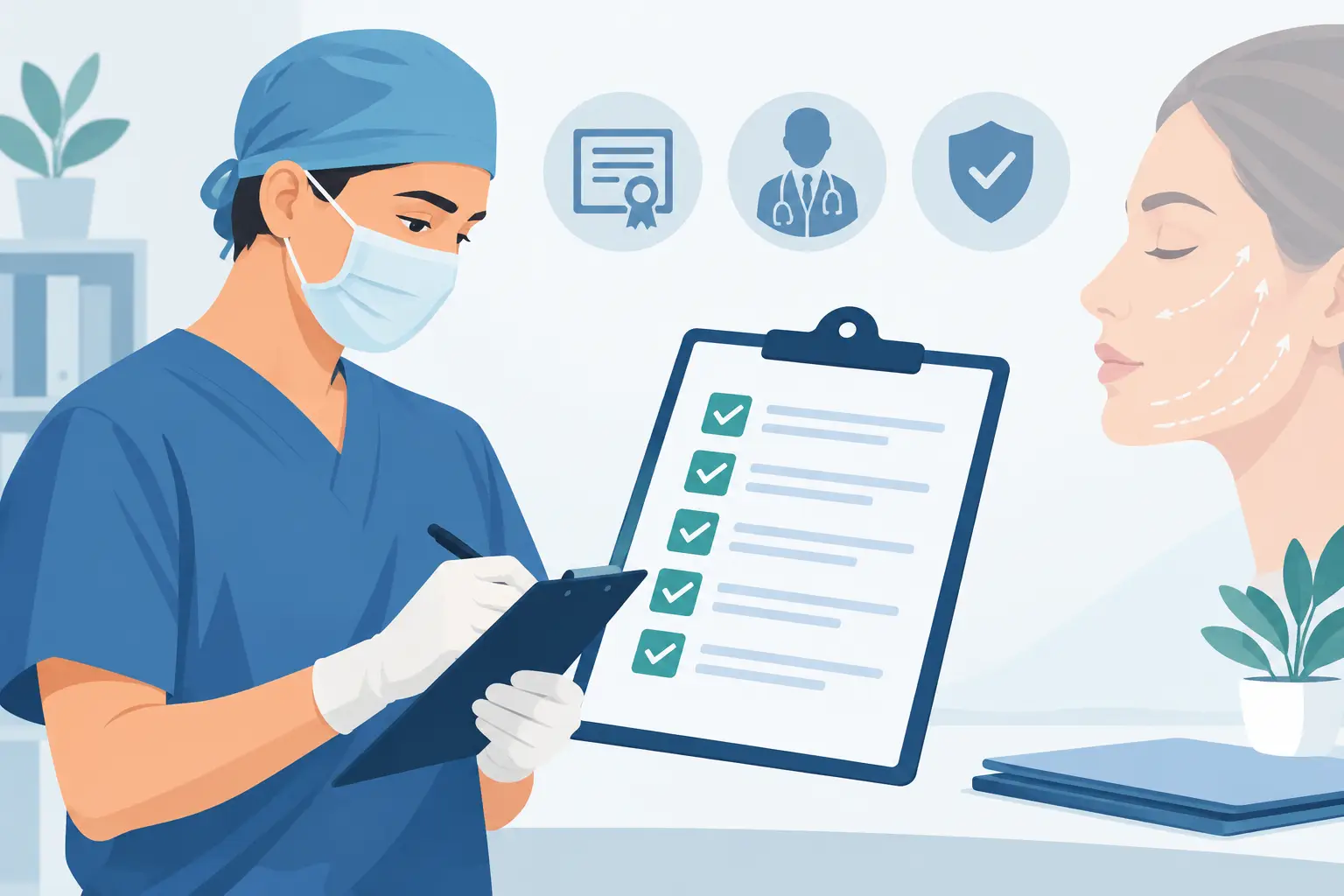
Surgeon Credential Review Checklist for Facelift Safety
A facelift is not the procedure to choose on price alone. The quality of the result, the safety of the operation, and the confidence you feel during recovery all begin with one decision: selecting a properly qualified surgeon. This surgeon credential review checklist is designed for patients considering facelift surgery in Mexico or abroad who want meaningful savings without accepting uncertainty.
A polished website, attractive before-and-after photos, or a low package price can be reassuring, but none replaces independent verification. A qualified surgeon should be comfortable answering direct questions about training, certification, hospital privileges, anesthesia, complication planning, and the type of facelift work they perform every week.
Start With the Surgeon, Not the Package
A medical tourism package can include transportation, accommodations, private nursing support, and beautiful recovery surroundings. Those details matter, especially after facial surgery. But they should be reviewed after you establish that the surgeon and surgical setting meet your standards.
For facelift patients, specialization matters. Facial rejuvenation requires more than the ability to perform cosmetic surgery generally. A surgeon may offer breast surgery, body contouring, injectables, and facial procedures, yet perform relatively few deep-plane facelifts or revision facelifts. Ask what portion of the surgeon’s practice is devoted to facelift surgery and related facial procedures.
Experience is not merely a matter of years in practice. It is also repetition, judgment, and familiarity with the small decisions that influence a natural result: skin redraping, neck contour, incision placement, bleeding control, and how to manage a patient whose tissues or anatomy call for a modified plan.
Surgeon Credential Review Checklist: What to Verify
Use the following points as a working checklist. A reputable practice should provide clear answers and give you time to understand them before requesting a deposit.
- Medical degree and specialty training: Confirm where the surgeon completed medical school, residency, and any cosmetic or facial surgery fellowship training. Training history should be specific, not described only as “internationally trained” or “highly experienced.”
- Recognized board certification: Ask which professional board certifies the surgeon and whether that certification is current. In Mexico, patients should understand the difference between a physician who performs cosmetic procedures and a surgeon certified by the appropriate national specialty board. If a provider is marketing to U.S. and Canadian patients, they should explain credentials in plain language rather than expecting you to interpret unfamiliar acronyms.
- Active license and good standing: Verify that the physician is licensed to practice where the surgery will occur. Ask whether there have been disciplinary actions, restrictions, or unresolved complaints. Every country has its own reporting systems, so the verification process may differ from what you know at home.
- Hospital privileges: A qualified facelift surgeon should have authorization to operate in the hospital or accredited surgical facility where your procedure is planned. Hospital privileges indicate that the facility has reviewed the surgeon’s qualifications for that type of work. They are not a guarantee of results, but they are a meaningful safety checkpoint.
- Facelift-specific case experience: Ask approximately how many facelift procedures the surgeon performs annually and which techniques they use most often. There is no universal number that automatically makes someone the right surgeon. Still, a surgeon who regularly performs facelift and neck procedures can speak clearly about candidacy, expected healing, scars, asymmetry, and revisions.
- Before-and-after photographs: Review consistent photo sets showing patients at similar angles and lighting. Look for patients in your age range with concerns similar to yours, such as jowls, neck laxity, deep folds, or loss of cheek definition. Ask how long after surgery the “after” images were taken.
- Anesthesia credentials: Learn who administers anesthesia, what their qualifications are, and whether they remain present throughout surgery. A facelift may be performed under different anesthesia approaches depending on the patient, procedure plan, and surgeon’s protocol. The right choice depends on your health history, not on what sounds most convenient.
- Emergency planning and transfer protocols: Ask what happens if an unexpected medical issue occurs during surgery or recovery. You should know whether the operation takes place in a full-service hospital, what monitoring is available, and how the team handles urgent evaluation after discharge.
Ask Questions That Reveal How the Practice Operates
Credentials are foundational, but the way a practice answers questions tells you a great deal about its standards. Be cautious if you receive vague replies, pressure to book quickly, or assurances that every patient is a perfect candidate.
Ask who performs each part of your care. Will you consult directly with the surgeon before surgery? Who completes preoperative testing? Who checks on you after the procedure? If you have swelling, drainage, pain, or concern during recovery, who is available and how quickly can they evaluate you?
You should also ask whether the quoted price includes the hospital, surgeon, anesthesia, medications, postoperative visits, transportation, and recovery accommodations. Lower pricing can be legitimate, particularly in Mexico where operating costs are lower than in the United States or Canada. Yet a quote is only useful when you know exactly what is included and what could create an additional expense.
A careful provider will also discuss factors that may make surgery less appropriate or require medical clearance. Smoking, uncontrolled blood pressure, blood-thinning medications, diabetes, prior facial surgery, and certain health conditions can change the plan. A practice that never asks for your complete medical history is not giving your case the attention it deserves.
Understand the Hospital and Recovery Environment
For an elective facelift, the surgical facility should be treated as part of the surgeon credential review. Confirm the name of the hospital before you travel. Ask whether it is a full-service facility, what level of postoperative observation is available, and where you will recover after discharge.
There is a practical trade-off here. Some patients want the familiarity of a hospital-based procedure and monitored initial recovery. Others may be candidates for an outpatient setting. The appropriate setting depends on the scope of surgery, anesthesia plan, age, medical history, and the surgeon’s judgment. What matters is that the recommendation is individualized and that the facility can support it.
Recovery arrangements deserve the same level of scrutiny. The first days after a facelift are when patients need rest, medication guidance, transportation, meals, and prompt access to medical advice. A private recovery retreat can be a comfortable and discreet option, but it should never be presented as a substitute for clinical oversight. Clarify who provides medical checks, how follow-up appointments are arranged, and how you will be transported safely between the hospital, recovery location, and surgeon’s office.
At FaceLiftMexico, the process is built around this sequence: a founder-led consultation, direct coordination with an experienced facelift surgeon, surgery in a full-service hospital, private driver assistance, and structured recovery in San Miguel de Allende. The goal is not simply to make surgery abroad feel luxurious. It is to remove avoidable logistical stress so patients can focus on safe healing.
Watch for Red Flags Before You Commit
A provider does not need to promise perfection to earn your trust. In fact, realistic discussion is usually a positive sign. Facelift surgery involves swelling, bruising, scars, temporary numbness, and a recovery period that takes patience. Like any operation, it carries risks.
Be especially cautious when a practice cannot identify the surgeon who will operate, will not name the hospital in advance, or relies on generic claims such as “certified” without identifying the certifying organization. Other concerns include heavily edited photos, identical results promised to every patient, requests for large nonrefundable payments before a medical review, and reluctance to discuss complications or revision policies.
Do not confuse warm communication with credential verification. You deserve both. Concierge-level care, beautiful accommodations, and attentive transportation can make a major difference in your experience, but the medical foundation must always come first.
Make the Final Decision With Clear Expectations
After completing your surgeon credential review checklist, compare your findings based on substance rather than marketing. The right choice may not be the lowest quote or the fastest available date. It is the surgeon and care team that can explain their qualifications, recommend an appropriate plan for your face and health, operate in a suitable facility, and remain accessible throughout recovery.
A quality facelift should leave you looking rested, refined, and recognizably yourself. Give yourself permission to ask detailed questions, request documentation, and pause if an answer feels incomplete. A trustworthy surgical team will see that caution not as an obstacle, but as the beginning of a well-supported journey.
0 comments